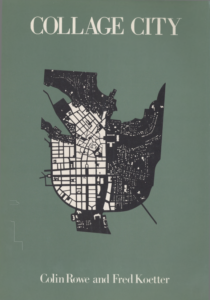
Colin Rowe and Fred Koetter in the 1970’s developed their ideas of a “Collage City” as an essay. Collage City was expanded and published as a book in 1979. Colin Rowe’s and Fred Koetter’s concept of collage as it does a critique of modern utopianism and a proposal for radical heterogeneity of appropriated form. And all these would seem to summarize much of architectural post modernism.
Rowe’s and Koetter’s concept of collage city can be a law as a model for architecture. The collage city is specified by Karl Popper’s anti- utopianism and fallibilism, Isaiah Berlin’s anti-hedgehog perception and the idea of bricoleur. This system is established on autonomous grid and heterogeneous fragments.
This book is a critical reappraisal of contemporary theories of urban planning and design and of the role of the architect-planner in an urban context. The authors, rejecting the grand utopian visions of “total planning” and “total design,” propose instead a “collage city” which can accommodate a whole range of utopias in miniature.
Download
Rowe_Collage City.pdf
Rowe_Collage City.txt