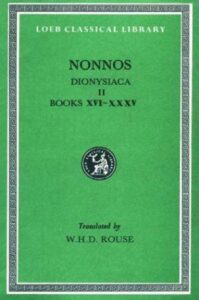
Nonnos, Dionysiaca Vol 2

Nonnos, Dionysiaca Vol 2 – cover

Nonnos of Panopolis in Egypt, who lived in the fifth century of our era, composed the last great epic poem of antiquity. The Dionysiaca, in 48 books, has for its chief theme the expedition of Dionysus against the Indians; but the poet contrives to include all the adventures of the god (as well as much other mythological lore) in a narrative which begins with chaos in heaven and ends with the apotheosis of Ariadne’s crown. The wild ecstasy inspired by the god is certainly reflected in the poet’s style, which is baroque, extravagant, and unrestrained. It seems that Nonnos was in later years converted to Christianity, for in marked contrast to the Dionysiaca, a poem dealing unreservedly with classical myths and redolent of a pagan outlook, there is extant and ascribed to him a hexameter paraphrase of the Gospel of John.

The Loeb Classical Library edition of the Dionysiaca is in three volumes.


Download

Nonnos_Dionysiaca Volume II: Books 16-35.pdf
Nonnos_Dionysiaca Volume II: Books 16-35.txt


RESEARCH & MEASUREMENT

Xenotheka is an experimental, password-protected research library exploring relationships between books, language, computation, and architectural knowledge.

BOOKS & RESEARCH DATA

The book collection is accessible only to authorised users for research and educational purposes. Access is personal. Passwords and access credentials must not be shared.

Full text versions may only be saved or printed for personal use or for research purposes. Books, texts, and protected research materials must not be reproduced, redistributed, published, passed on to third parties, or commercially exploited. Downloaded material must be deleted by completion of the course. Existing copyright notices and rights-holder information must not be removed or altered.

Copyright remains with the respective rights holders. Computational representations, classifications, and relationships between texts are experimental research outputs and may contain errors or interpretive biases.

MEASUREMENT

We study how visitors navigate and explore the library, including interactions with books, searches, visualisations, and research tools.

Entering the library includes taking part in this measurement: Google Analytics records visits, clicks, navigation, and interface interactions. Book contents, passwords, and the full text of searches are not transmitted to Google Analytics.

This agreement covers both sites, Xenotheka (xenotheka.com) and Ask.Alice_ch3n81 (ask.alice-ch3n81.net): agreeing on one is agreeing on the other. It is valid for 24 hours and is then asked again.

Thank you for reading, exploring, and contributing to the experiment.