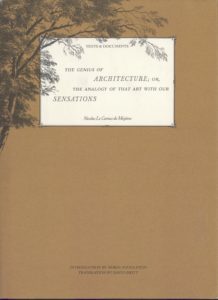
Le Camus de Mezieres, The Genius of Architecture


Nicolas Le Camus de Mézières (1721–circa 1793) emerges today as one of the more fascinating and influential architects of the French Enlightenment. Much admired by his contemporaries for his large circular market, the Halle au Blé (1763–67), Le Camus made his very significant mark on French Neoclassical theory with his fanciful and quixotic study The Genius of Architecture; or, The Analogy of That Art with Our Sensations (1780). In part a handbook on the planning of the French hôtel, in part a sensationalist exploration of form and its sentimental or expressive value—Le Camus’s always discreet and politic analysis argues the point that architecture should please the senses as well as the mind. Not only did such a proposition bring to a conclusion the theories of planning and caractère put forward by Germain Boffrand and Jacques-François Blondel, it also supplied the theoretical underpinning for the formal explorations of Etienne-Louis Boullée, Claude-Nicolas Ledoux, and John Soane. These issues and others are considered in the masterly and informative introduction by Professor Robin Middleton, which traces the theoretical development of such ideas through classical times and the eighteenth-century theories of Jean-Louis de Cordemoy, Jean-Baptiste Dubos, Roger de Piles, Etienne Bonnot de Condillac, Claude-Henri Watelet, Thomas Whateley, and Jean-Marie Morel.


Download

Le Camus de Mezieres_The Genius of Architecture.pdf
Le Camus de Mezieres_The Genius of Architecture.txt


RESEARCH & MEASUREMENT

Xenotheka is an experimental, password-protected research library exploring relationships between books, language, computation, and architectural knowledge.

BOOKS & RESEARCH DATA

The book collection is accessible only to authorised users for research and educational purposes. Access is personal. Passwords and access credentials must not be shared.

Full text versions may only be saved or printed for personal use or for research purposes. Books, texts, and protected research materials must not be reproduced, redistributed, published, passed on to third parties, or commercially exploited. Downloaded material must be deleted by completion of the course. Existing copyright notices and rights-holder information must not be removed or altered.

Copyright remains with the respective rights holders. Computational representations, classifications, and relationships between texts are experimental research outputs and may contain errors or interpretive biases.

MEASUREMENT

We study how visitors navigate and explore the library, including interactions with books, searches, visualisations, and research tools.

Entering the library includes taking part in this measurement: Google Analytics records visits, clicks, navigation, and interface interactions. Book contents, passwords, and the full text of searches are not transmitted to Google Analytics.

This agreement covers both sites, Xenotheka (xenotheka.com) and Ask.Alice_ch3n81 (ask.alice-ch3n81.net): agreeing on one is agreeing on the other. It is valid for 24 hours and is then asked again.

Thank you for reading, exploring, and contributing to the experiment.