Franz Theodor Kugler (19 January 1808, Stettin – 18 March 1858, Berlin) was an art historian and cultural administrator for the Prussian state.He was the father of historian Bernhard von Kugler (1837-1898).
He studied literature, music and the visual arts at the University of Berlin. After attending classes in Heidelberg, he returned to Berlin in 1827 in order to study architecture. In 1831 he obtained his doctorate under Ernst Heinrich Toelken with a dissertation on Werinher of Tegernsee. In 1833 he was appointed professor of art history at the Prussian Academy of Arts in Berlin, and ten years later, was named to the Ministry of Culture, from which he served as an overseer of Prussian art. Cultural historian, Jakob Burckhardt, was a prominent student of his.
In 1837 he released his “Handbuch der Geschichte der Malerei” (2 volumes), and a few years later, he published the acclaimed “Handbuch der Kunstgeschichte”, a comprehensive survey of world art. He was also the author of a biography on Frederick the Great, “Geschichte Friedrichs des Großen” (1840) and of a monograph on architect Karl Friedrich Schinkel (1842).
From 1833 to 1837, he was editor of the journal “Museum, Blätter für bildende Kunst”. Johannes Brahms employed text written by Kugler for his Ständchen (“Der Mond steht über dem Berge”), a song for voice and piano, Op. 106/1.
Download
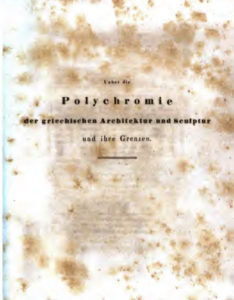
Kugler_Über die Polychromie der griechischen Architektur und Skulptur und ihre Grenzen.pdf