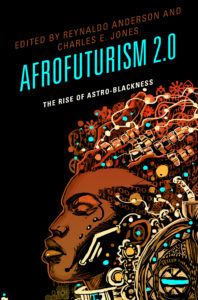
Anderson, Afrofuturism 2.0: The Rise of Astro-Blackness

The ideas and practices related to afrofuturism have existed for most of the 20th century, especially in the north American African diaspora community. After Mark Dery coined the word “afrofuturism” in 1993, Alondra Nelson as a member of an online forum, along with other participants, began to explore the initial terrain and intellectual underpinnings of the concept noting that “AfroFuturism has emerged as a term of convenience to describe analysis, criticism and cultural production that addresses the intersections between race and technology.” Afrofuturism 2.0: The Rise of Astroblackness represents a transition from previous ideas related to afrofuturism that were formed in the late 20th century around issues of the digital divide, music and literature. Afrofuturism 2.0 expands and broadens the discussion around the concept to include religion, architecture, communications, visual art, philosophy and reflects its current growth as an emerging global Pan African creative phenomenon.


Download

Anderson_Afrofuturism 2.0: The Rise of Astro-Blackness.pdf
Anderson_Afrofuturism 2.0: The Rise of Astro-Blackness.txt


RESEARCH & MEASUREMENT

Xenotheka is an experimental, password-protected research library exploring relationships between books, language, computation, and architectural knowledge.

BOOKS & RESEARCH DATA

The book collection is accessible only to authorised users for research and educational purposes. Access is personal. Passwords and access credentials must not be shared.

Full text versions may only be saved or printed for personal use or for research purposes. Books, texts, and protected research materials must not be reproduced, redistributed, published, passed on to third parties, or commercially exploited. Downloaded material must be deleted by completion of the course. Existing copyright notices and rights-holder information must not be removed or altered.

Copyright remains with the respective rights holders. Computational representations, classifications, and relationships between texts are experimental research outputs and may contain errors or interpretive biases.

MEASUREMENT

We study how visitors navigate and explore the library, including interactions with books, searches, visualisations, and research tools.

Entering the library includes taking part in this measurement: Google Analytics records visits, clicks, navigation, and interface interactions. Book contents, passwords, and the full text of searches are not transmitted to Google Analytics.

This agreement covers both sites, Xenotheka (xenotheka.com) and Ask.Alice_ch3n81 (ask.alice-ch3n81.net): agreeing on one is agreeing on the other. It is valid for 24 hours and is then asked again.

Thank you for reading, exploring, and contributing to the experiment.