Sophocles, Oedipus at Colonus

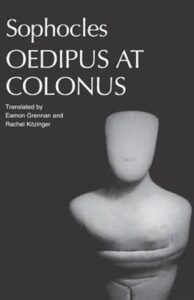
Sophocles, Oedipus at Colonus – cover


Sophocles’ Oedipus at Colonus tells the story of the last day in the life of Oedipus. It was written at the end of the fifth century BCE in Athens, in the final years of the “Golden Age” of Athenian culture, and in the last year of Sophocles’ own life. At the center of the play is the mysterious transformation of Oedipus from an old and blind beggar, totally dependent on his daughters, to the man who rises from his seat and, without help, leads everyone to the place where he is destined to die. In the background of this transformation stands the grove of the Furies, the sacred place of the implacable goddesses who pursue the violators of blood relationships. Although Oedipus, who killed his father and married his mother, is an obvious target of the Furies’ vengeance, he enters their grove at the beginning of the play, sure that it is the resting place Apollo has predicted for him. The reversals and paradoxes in the play speak to the struggle that Oedipus’ life and the action of the play bring vividly before us: how do we as humans, subject to constant change, find stable ground on which to stand and define our moral lives? Sophocles offers his play as a witness to the remarkable human capacity to persevere in this struggle.


Download

Sophocles_Oedipus at Colonus.pdf
Sophocles_Oedipus at Colonus.txt


RESEARCH & MEASUREMENT

Xenotheka is an experimental, password-protected research library exploring relationships between books, language, computation, and architectural knowledge.

BOOKS & RESEARCH DATA

The book collection is accessible only to authorised users for research and educational purposes. Access is personal. Passwords and access credentials must not be shared.

Full text versions may only be saved or printed for personal use or for research purposes. Books, texts, and protected research materials must not be reproduced, redistributed, published, passed on to third parties, or commercially exploited. Downloaded material must be deleted by completion of the course. Existing copyright notices and rights-holder information must not be removed or altered.

Copyright remains with the respective rights holders. Computational representations, classifications, and relationships between texts are experimental research outputs and may contain errors or interpretive biases.

MEASUREMENT

We study how visitors navigate and explore the library, including interactions with books, searches, visualisations, and research tools.

Entering the library includes taking part in this measurement: Google Analytics records visits, clicks, navigation, and interface interactions. Book contents, passwords, and the full text of searches are not transmitted to Google Analytics.

This agreement covers both sites, Xenotheka (xenotheka.com) and Ask.Alice_ch3n81 (ask.alice-ch3n81.net): agreeing on one is agreeing on the other. It is valid for 24 hours and is then asked again.

Thank you for reading, exploring, and contributing to the experiment.