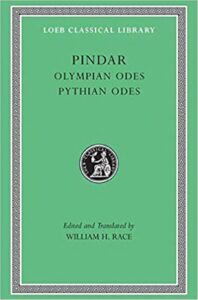
Pindar, Olympian Odes. Pythian Odes

Pindar, Olympian Odes. Pythian Odes

Of the Greek lyric poets, Pindar (ca. 518-438 BCE) was “by far the greatest for the magnificence of his inspiration” in Quintilian’s view; Horace judged him “sure to win Apollo’s laurels.” The esteem of the ancients may help explain why a good portion of his work was carefully preserved. Most of the Greek lyric poets come down to us only in bits and pieces, but nearly a quarter of Pindar’s poems survive complete. William H. Race now brings us, in two volumes, a new edition and translation of the four books of victory odes, along with surviving fragments of Pindar’s other poems.

Like Simonides and Bacchylides, Pindar wrote elaborate odes in honor of prize-winning athletes for public performance by singers, dancers, and musicians. His forty-five victory odes celebrate triumphs in athletic contests at the four great Panhellenic festivals: the Olympic, Pythian (at Delphi), Nemean, and Isthmian games. In these complex poems, Pindar commemorates the achievement of athletes and powerful rulers against the backdrop of divine favor, human failure, heroic legend, and the moral ideals of aristocratic Greek society. Readers have long savored them for their rich poetic language and imagery, moral maxims, and vivid portrayals of sacred myths.


Download

Pindar_Olympian Odes. Pythian Odes.pdf
Pindar_Olympian Odes. Pythian Odes.txt


RESEARCH & MEASUREMENT

Xenotheka is an experimental, password-protected research library exploring relationships between books, language, computation, and architectural knowledge.

BOOKS & RESEARCH DATA

The book collection is accessible only to authorised users for research and educational purposes. Access is personal. Passwords and access credentials must not be shared.

Full text versions may only be saved or printed for personal use or for research purposes. Books, texts, and protected research materials must not be reproduced, redistributed, published, passed on to third parties, or commercially exploited. Downloaded material must be deleted by completion of the course. Existing copyright notices and rights-holder information must not be removed or altered.

Copyright remains with the respective rights holders. Computational representations, classifications, and relationships between texts are experimental research outputs and may contain errors or interpretive biases.

MEASUREMENT

We study how visitors navigate and explore the library, including interactions with books, searches, visualisations, and research tools.

Entering the library includes taking part in this measurement: Google Analytics records visits, clicks, navigation, and interface interactions. Book contents, passwords, and the full text of searches are not transmitted to Google Analytics.

This agreement covers both sites, Xenotheka (xenotheka.com) and Ask.Alice_ch3n81 (ask.alice-ch3n81.net): agreeing on one is agreeing on the other. It is valid for 24 hours and is then asked again.

Thank you for reading, exploring, and contributing to the experiment.