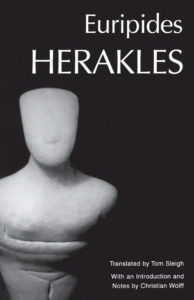
Euripides, Heracles

“Heracles” or “The Madness of Heracles” is a tragedy by the ancient Greek playwright Euripides. It describes the frenzy of divinely induced madness of the Greek hero Heracles which led him to kill his own wife and children. It was written around 416 BCE or earlier, the second of two surviving plays by Euripides concerning the family of Heracles (the first being the “Heraclidae”), and was first produced at the Dionysia festival of Athens, although it did not win any prize.


Download

Euripides_Herakles.pdf
Euripides_Herakles.txt


RESEARCH & MEASUREMENT

Xenotheka is an experimental, password-protected research library exploring relationships between books, language, computation, and architectural knowledge.

BOOKS & RESEARCH DATA

The book collection is accessible only to authorised users for research and educational purposes. Access is personal. Passwords and access credentials must not be shared.

Full text versions may only be saved or printed for personal use or for research purposes. Books, texts, and protected research materials must not be reproduced, redistributed, published, passed on to third parties, or commercially exploited. Downloaded material must be deleted by completion of the course. Existing copyright notices and rights-holder information must not be removed or altered.

Copyright remains with the respective rights holders. Computational representations, classifications, and relationships between texts are experimental research outputs and may contain errors or interpretive biases.

MEASUREMENT

We study how visitors navigate and explore the library, including interactions with books, searches, visualisations, and research tools.

Entering the library includes taking part in this measurement: Google Analytics records visits, clicks, navigation, and interface interactions. Book contents, passwords, and the full text of searches are not transmitted to Google Analytics.

This agreement covers both sites, Xenotheka (xenotheka.com) and Ask.Alice_ch3n81 (ask.alice-ch3n81.net): agreeing on one is agreeing on the other. It is valid for 24 hours and is then asked again.

Thank you for reading, exploring, and contributing to the experiment.