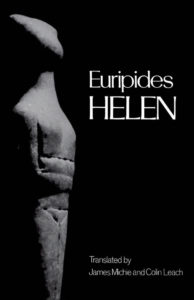
Euripides, Helen

Helen is not the most famous of Euripides’ plays, but it is one of the most curious – and it deserves close analysis and study. The play was first performed in 412 BC at that year’s City Dionysia. In summary, the plot of Helen turns on an old conspiracy theory first put forward by the ancient historian Herodotus: that ‘Helen of Troy’ was a mere phantom conjured by Hera, and that the real wife of Menelaus spent the duration of the Trojan War in Egypt, having been taken there by Hermes and kept safe out of harm’s way. The Greeks and the Trojans both go to war over what is, effectively, an illusion. The goddess Hera is responsible for the phantom Helen and, therefore, the cause of the Trojan War: she’s seeking revenge on mortals over something called the Judgement of Paris.

Helen lives out seventeen long years in Egypt, chastely and loyally waiting for her husband Menelaus to come and fetch her. Like Penelope in Homer’s Odyssey, she refuses to accept that her husband is definitely dead and rejects the offer of marriage from the new king of Egypt, Theoclymenus. But he won’t wait forever.


Download

Euripides_Helen.pdf
Euripides_Helen.txt


RESEARCH & MEASUREMENT

Xenotheka is an experimental, password-protected research library exploring relationships between books, language, computation, and architectural knowledge.

BOOKS & RESEARCH DATA

The book collection is accessible only to authorised users for research and educational purposes. Access is personal. Passwords and access credentials must not be shared.

Full text versions may only be saved or printed for personal use or for research purposes. Books, texts, and protected research materials must not be reproduced, redistributed, published, passed on to third parties, or commercially exploited. Downloaded material must be deleted by completion of the course. Existing copyright notices and rights-holder information must not be removed or altered.

Copyright remains with the respective rights holders. Computational representations, classifications, and relationships between texts are experimental research outputs and may contain errors or interpretive biases.

MEASUREMENT

We study how visitors navigate and explore the library, including interactions with books, searches, visualisations, and research tools.

Entering the library includes taking part in this measurement: Google Analytics records visits, clicks, navigation, and interface interactions. Book contents, passwords, and the full text of searches are not transmitted to Google Analytics.

This agreement covers both sites, Xenotheka (xenotheka.com) and Ask.Alice_ch3n81 (ask.alice-ch3n81.net): agreeing on one is agreeing on the other. It is valid for 24 hours and is then asked again.

Thank you for reading, exploring, and contributing to the experiment.