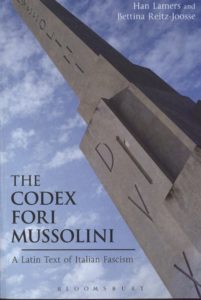
Lammer, Joose, The Codex Fori Mussolini


The year is 1932. In Rome, the Fascist leader Benito Mussolini unveils a giant obelisk of white marble, bearing the Latin inscription MVSSOLINI DVX. Invisible to the cheering crowds, a metal box lies immured in the obelisk’s base. It contains a few gold coins and, written on a piece of parchment, a Latin text: the Codex fori Mussolini. What does this text say? Why was it buried there? And why was it written in Latin?

The Codex, composed by the classical scholar Aurelio Giuseppe Amatucci (1867-1960), presents a carefully constructed account of the rise of Italian Fascism and its leader, Benito Mussolini. Though written in the language of Roman antiquity, the Codex was supposed to reach audiences in the distant future. Placed under the obelisk with future excavation and rediscovery in mind, the Latin text was an attempt at directing the future reception of Italian Fascism.

This book renders the Codex accessible to scholars and students of different disciplines, offering a thorough and wide-ranging introduction, a clear translation, and a commentary elucidating the text’s rhetorical strategies, historical background, and specifics of phrasing and reference. As the first detailed study of a Fascist Latin text, it also throws new light on the important role of the Latin language in Italian Fascist culture.


Download

Lammer, Joose_The Codex Fori Mussolini.pdf
Lammer, Joose_The Codex Fori Mussolini.txt


RESEARCH & MEASUREMENT

Xenotheka is an experimental, password-protected research library exploring relationships between books, language, computation, and architectural knowledge.

BOOKS & RESEARCH DATA

The book collection is accessible only to authorised users for research and educational purposes. Access is personal. Passwords and access credentials must not be shared.

Full text versions may only be saved or printed for personal use or for research purposes. Books, texts, and protected research materials must not be reproduced, redistributed, published, passed on to third parties, or commercially exploited. Downloaded material must be deleted by completion of the course. Existing copyright notices and rights-holder information must not be removed or altered.

Copyright remains with the respective rights holders. Computational representations, classifications, and relationships between texts are experimental research outputs and may contain errors or interpretive biases.

MEASUREMENT

We study how visitors navigate and explore the library, including interactions with books, searches, visualisations, and research tools.

Entering the library includes taking part in this measurement: Google Analytics records visits, clicks, navigation, and interface interactions. Book contents, passwords, and the full text of searches are not transmitted to Google Analytics.

This agreement covers both sites, Xenotheka (xenotheka.com) and Ask.Alice_ch3n81 (ask.alice-ch3n81.net): agreeing on one is agreeing on the other. It is valid for 24 hours and is then asked again.

Thank you for reading, exploring, and contributing to the experiment.