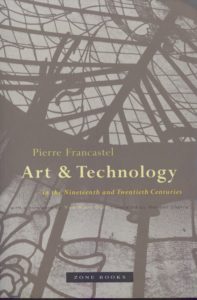
Francastel, Art and Technology in the Nineteenth and Twentieth Centuries


Although the work of Pierre Francastel (1900-1970) has long carried the label “sociology of art,” it bears little resemblance to anything conventionally sociological. For too long Francastel has been unavailable to English-language readers, and hence known only through erroneous and secondhand characterizations. This translation of Art and Technology should open the way for a rediscovery and reconsideration of this brilliant, often misunderstood thinker. Unlike adherents of the dominant schools of Anglo-American and German art history, Francastel was not obsessed with establishing a quasi-scientific methodology as the basis for his studies. But as art history itself is being reshaped by the culture of technology, his nuanced meditations from the 1950s on the intricate intersection of technology and art gain heightened value. The concrete objects that Francastel examines are for the most part from the architecture and design of the late nineteenth to mid-twentieth century. Through them he engages his central problem: the abrupt historical collision between traditional symbol-making activities of human society and the appearance in the nineteenth century of unprecedented technological and industrial capabilities and forms. Francastel’s vision of the indeterminate, shifting relation between the aesthetic and the technological will be of crucial interest to anyone interested in the history of art, architecture, and design.


Download

Francastel_Art and Technology in the Nineteenth and Twentieth Centuries.pdf
Francastel_Art and Technology in the Nineteenth and Twentieth Centuries.txt


RESEARCH & MEASUREMENT

Xenotheka is an experimental, password-protected research library exploring relationships between books, language, computation, and architectural knowledge.

BOOKS & RESEARCH DATA

The book collection is accessible only to authorised users for research and educational purposes. Access is personal. Passwords and access credentials must not be shared.

Full text versions may only be saved or printed for personal use or for research purposes. Books, texts, and protected research materials must not be reproduced, redistributed, published, passed on to third parties, or commercially exploited. Downloaded material must be deleted by completion of the course. Existing copyright notices and rights-holder information must not be removed or altered.

Copyright remains with the respective rights holders. Computational representations, classifications, and relationships between texts are experimental research outputs and may contain errors or interpretive biases.

MEASUREMENT

We study how visitors navigate and explore the library, including interactions with books, searches, visualisations, and research tools.

Entering the library includes taking part in this measurement: Google Analytics records visits, clicks, navigation, and interface interactions. Book contents, passwords, and the full text of searches are not transmitted to Google Analytics.

This agreement covers both sites, Xenotheka (xenotheka.com) and Ask.Alice_ch3n81 (ask.alice-ch3n81.net): agreeing on one is agreeing on the other. It is valid for 24 hours and is then asked again.

Thank you for reading, exploring, and contributing to the experiment.