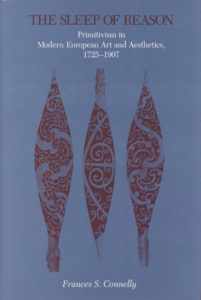
Art historians have in the past narrowly defined primitivism, limiting their inquiry to examples of direct stylistic borrowing from African, Oceanic, or Native American imagery. The drawbacks of such an approach have become increasingly apparent, the most problematic being its perpetuation of the notion that certain traditions are indeed “primitive.” Frances Connelly argues that “primitive” art was not a style at all, but a cultural construction by modern Europeans, a cluster of concepts principally forged during the Enlightenment concerning the nature of the origins of artistic expression. She contends that, instead of the paintings of Gauguin, the publication of Vico’s New Science in 1725 lies much closer to the origins of primitivism because it first articulated the essential framework of ideas through which Europeans would understand “primitive” expression.
Download
Connelly_The Sleep of Reason.pdf
Connelly_The Sleep of Reason.txt