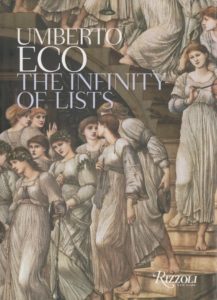
Eco, The Infinity of Lists


In the history of Western culture we find lists of saints, ranks of soldiers, catalogues of grotesque creatures or medicinal plants, and hordes of treasure. This infinity of lists is no coincidence: a culture prefers enclosed, stable forms when it is sure of its own identity, while when faced with a jumbled series of ill-defined phenomena, it starts making lists. The poetics of lists runs throughout the history of art and literature. We do not only see it at work in ancient bestiaries, the celestial hosts of angels or the naturalist collections of the 16th century. We also find it more obliquely from Homer to Joyce, from the treasures of Gothic cathedrals to the fantastic landscapes of Bosch and cabinets of curiosities, until we get to Andy Warhol and Arman in the 20th century. In this 5-colour illustrated edition, Umberto Eco reflects on how the idea of catalogues has changed over the centuries and how, from one period to another, it has expressed the spirit of the times. His essay is accompanied by a literary anthology and a wide selection of works of art illustrating and analyzing the texts presented. This new illustrated essay is a companion volume to On Beauty and On Ugliness.


Download

Eco_The Infinity of Lists.pdf
Eco_The Infinity of Lists.txt


RESEARCH & MEASUREMENT

Xenotheka is an experimental, password-protected research library exploring relationships between books, language, computation, and architectural knowledge.

BOOKS & RESEARCH DATA

The book collection is accessible only to authorised users for research and educational purposes. Access is personal. Passwords and access credentials must not be shared.

Full text versions may only be saved or printed for personal use or for research purposes. Books, texts, and protected research materials must not be reproduced, redistributed, published, passed on to third parties, or commercially exploited. Downloaded material must be deleted by completion of the course. Existing copyright notices and rights-holder information must not be removed or altered.

Copyright remains with the respective rights holders. Computational representations, classifications, and relationships between texts are experimental research outputs and may contain errors or interpretive biases.

MEASUREMENT

We study how visitors navigate and explore the library, including interactions with books, searches, visualisations, and research tools.

Entering the library includes taking part in this measurement: Google Analytics records visits, clicks, navigation, and interface interactions. Book contents, passwords, and the full text of searches are not transmitted to Google Analytics.

This agreement covers both sites, Xenotheka (xenotheka.com) and Ask.Alice_ch3n81 (ask.alice-ch3n81.net): agreeing on one is agreeing on the other. It is valid for 24 hours and is then asked again.

Thank you for reading, exploring, and contributing to the experiment.