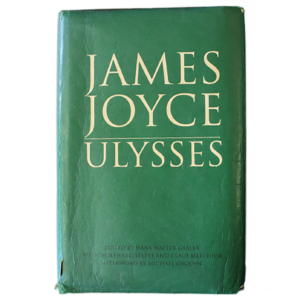
Joyce, Ulysses


Ulysses is a modernist novel by Irish writer James Joyce. It is considered to be one of the most important works of modernist literature and has been called “a demonstration and summation of the entire movement. According to Declan Kiberd, “Before Joyce, no writer of fiction had so foregrounded the process of thinking”.

Ulysses chronicles the peripatetic appointments and encounters of Leopold Bloom in Dublin in the course of an ordinary day, 16 June 1904. Ulysses is the Latinised name of Odysseus, the hero of Homer’s epic poem the Odyssey, and the novel establishes a series of parallels between the poem and the novel, with structural correspondences between the characters and experiences of Leopold Bloom and Odysseus, Molly Bloom and Penelope, and Stephen Dedalus and Telemachus, in addition to events and themes of the early 20th-century context of modernism, Dublin, and Ireland’s relationship to Britain. The novel is highly allusive and also imitates the styles of different periods of English literature.

Since its publication, the book has attracted controversy and scrutiny, ranging from an obscenity trial in the United States in 1921, to protracted textual “Joyce Wars”. The novel’s stream-of-consciousness technique, careful structuring, and experimental prose—replete with puns, parodies, and allusions—as well as its rich characterisation and broad humour, have led it to be regarded as one of the greatest literary works in history; Joyce fans worldwide now celebrate 16 June as Bloomsday.


Download

Joyce_Ulysses.pdf
Joyce_Ulysses.txt


RESEARCH & MEASUREMENT

Xenotheka is an experimental, password-protected research library exploring relationships between books, language, computation, and architectural knowledge.

BOOKS & RESEARCH DATA

The book collection is accessible only to authorised users for research and educational purposes. Access is personal. Passwords and access credentials must not be shared.

Full text versions may only be saved or printed for personal use or for research purposes. Books, texts, and protected research materials must not be reproduced, redistributed, published, passed on to third parties, or commercially exploited. Downloaded material must be deleted by completion of the course. Existing copyright notices and rights-holder information must not be removed or altered.

Copyright remains with the respective rights holders. Computational representations, classifications, and relationships between texts are experimental research outputs and may contain errors or interpretive biases.

MEASUREMENT

We study how visitors navigate and explore the library, including interactions with books, searches, visualisations, and research tools.

Entering the library includes taking part in this measurement: Google Analytics records visits, clicks, navigation, and interface interactions. Book contents, passwords, and the full text of searches are not transmitted to Google Analytics.

This agreement covers both sites, Xenotheka (xenotheka.com) and Ask.Alice_ch3n81 (ask.alice-ch3n81.net): agreeing on one is agreeing on the other. It is valid for 24 hours and is then asked again.

Thank you for reading, exploring, and contributing to the experiment.