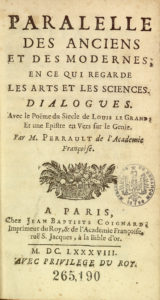
The first volume of the Parallèle draws to a close with two pieces in verse, the Siècle de Louis le Grand, already published the preceding year which was the cause and the origin of the book, and the epistle to M. de Fontenelle Le génie; in fact Pierre and Thomas Corneille’s nephew made a name for himself with his Digression sur les Anciens et les Modernes (Paris, 1688) as a formidable partisan of the Moderns. The three other volumes, published by the widow and the son of Jean-Baptiste Coignard who had died in 1689, deal respectively with eloquence (1690), poetry (1692) and various subjects such as astronomy, geography, philosophy, etc. (1697). The bookseller-printers made the most of the situation and re-issued the first two volumes in 1692 and 1693. Those who took sides with the Ancients were unquestionably supported by Versailles. Charles, often abhorred because of his role close to Colbert, might have harmed the cause of the Moderns until the appearance in the controversy of Fontenelle, a brilliant independent mind, a recognized scientific figure whose arguments had quite a different scope. In spite of the truce made official by Boileau’s and Perrault’s public embrace (as leaders of the two coteries) the quarrel took on international proportions at the end of the 17th century and the “Quarrel on Homer” was to ignite Paris as well as London and Naples.
Download
Perrault_Parallèle des Anciens et des Modernes.pdf