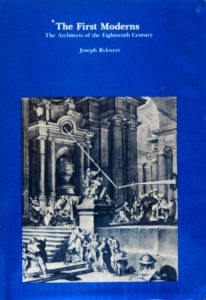
Rykwert, The First Moderns


The First Moderns portrays the complex of social and personal relationships, patronage, humanistic learning, and mystical and hermetic philosophy that made up the world of the “classic” in Europe from around 1650 to 1775. Against this background, it traces a subtle but revolutionary change that occurred in European architecture and which aroused issues that still echo in the debates between architectural traditionalists and modernists and between modernists and postmodernists.

Rykwert’s study goes well beyond the tradition of architectural history, which has largely been concerned with the outward, stylistic evolution from the classic to the Baroque and Rococo. It examines buildings as embodiments of the whole culture, founded on basic philosophical concepts and shaped by ongoing political and religious upheavals. In particular, it focuses on the shift from the “classic” to the “Neoclassic.”

The study includes major painters and sculptors of the period and pays considerable attention to the practical and social context in which the architects, artists, and artisans worked—the organization of labor, the establishment of the Academies and of the architectural profession, the development of the building guilds, and the rise of freemasonry. The book concludes with an extensive bibliography and index.


Download

Rykwert_The First Moderns.pdf
Rykwert_The First Moderns.txt


RESEARCH & MEASUREMENT

Xenotheka is an experimental, password-protected research library exploring relationships between books, language, computation, and architectural knowledge.

BOOKS & RESEARCH DATA

The book collection is accessible only to authorised users for research and educational purposes. Access is personal. Passwords and access credentials must not be shared.

Full text versions may only be saved or printed for personal use or for research purposes. Books, texts, and protected research materials must not be reproduced, redistributed, published, passed on to third parties, or commercially exploited. Downloaded material must be deleted by completion of the course. Existing copyright notices and rights-holder information must not be removed or altered.

Copyright remains with the respective rights holders. Computational representations, classifications, and relationships between texts are experimental research outputs and may contain errors or interpretive biases.

MEASUREMENT

We study how visitors navigate and explore the library, including interactions with books, searches, visualisations, and research tools.

Entering the library includes taking part in this measurement: Google Analytics records visits, clicks, navigation, and interface interactions. Book contents, passwords, and the full text of searches are not transmitted to Google Analytics.

This agreement covers both sites, Xenotheka (xenotheka.com) and Ask.Alice_ch3n81 (ask.alice-ch3n81.net): agreeing on one is agreeing on the other. It is valid for 24 hours and is then asked again.

Thank you for reading, exploring, and contributing to the experiment.