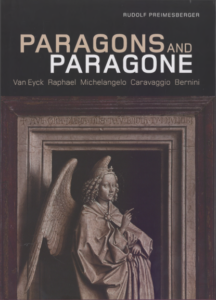
Preimesberger, Paragons And Paragone


The paragone―the notion of competition and rivalry among the arts―has been a topic of debate for centuries. It erupted with great force in the Renaissance, with sculptors vying with painters for superiority, modern artists competing with the ancients, and painting challenging poetry. If the traces of this lively conversation are most evident in the literature, the remarkable scholarship presented here demonstrates how the paragone was rendered visible also in works of art.

The essays on Renaissance and Baroque art reveal the paragone to be a crucial motive and key to the interpretation of some of the most celebrated works of art such as Van Eyck’s Ghent Altarpiece and Michelangelo’s Pietà in St. Peter’s Basilica. The author’s incisive and erudite analysis of social history, biography, rhetoric, art theory, wordplay, and history illuminates these works anew, thus affording a modern audience a better understanding of the subtleties of their composition and meaning. Readers will find surprising insights and unsuspected drama in works of art they may have thought they knew.


Download

Preimesberger_Paragons and Paragone.pdf
Preimesberger_Paragons and Paragone.txt


RESEARCH & MEASUREMENT

Xenotheka is an experimental, password-protected research library exploring relationships between books, language, computation, and architectural knowledge.

BOOKS & RESEARCH DATA

The book collection is accessible only to authorised users for research and educational purposes. Access is personal. Passwords and access credentials must not be shared.

Full text versions may only be saved or printed for personal use or for research purposes. Books, texts, and protected research materials must not be reproduced, redistributed, published, passed on to third parties, or commercially exploited. Downloaded material must be deleted by completion of the course. Existing copyright notices and rights-holder information must not be removed or altered.

Copyright remains with the respective rights holders. Computational representations, classifications, and relationships between texts are experimental research outputs and may contain errors or interpretive biases.

MEASUREMENT

We study how visitors navigate and explore the library, including interactions with books, searches, visualisations, and research tools.

Entering the library includes taking part in this measurement: Google Analytics records visits, clicks, navigation, and interface interactions. Book contents, passwords, and the full text of searches are not transmitted to Google Analytics.

This agreement covers both sites, Xenotheka (xenotheka.com) and Ask.Alice_ch3n81 (ask.alice-ch3n81.net): agreeing on one is agreeing on the other. It is valid for 24 hours and is then asked again.

Thank you for reading, exploring, and contributing to the experiment.