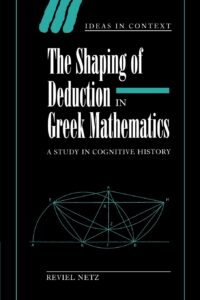
Netz, The Shaping of Deduction in Greek Mathematics

Netz, The Shaping of Deduction in Greek Mathematics

Reviel Netz’s cognitive history of Greek mathematics. The lettered diagram and a small, formulaic language made deduction possible, and the book reads Euclid and Archimedes through their practices of writing and drawing.

Cambridge University Press, 1999.


Download

Netz_The Shaping of Deduction in Greek Mathematics.pdf
Netz_The Shaping of Deduction in Greek Mathematics.txt


RESEARCH & MEASUREMENT

Xenotheka is an experimental, password-protected research library exploring relationships between books, language, computation, and architectural knowledge.

BOOKS & RESEARCH DATA

The book collection is accessible only to authorised users for research and educational purposes. Access is personal. Passwords and access credentials must not be shared.

Full text versions may only be saved or printed for personal use or for research purposes. Books, texts, and protected research materials must not be reproduced, redistributed, published, passed on to third parties, or commercially exploited. Downloaded material must be deleted by completion of the course. Existing copyright notices and rights-holder information must not be removed or altered.

Copyright remains with the respective rights holders. Computational representations, classifications, and relationships between texts are experimental research outputs and may contain errors or interpretive biases.

MEASUREMENT

We study how visitors navigate and explore the library, including interactions with books, searches, visualisations, and research tools.

Entering the library includes taking part in this measurement: Google Analytics records visits, clicks, navigation, and interface interactions. Book contents, passwords, and the full text of searches are not transmitted to Google Analytics.

This agreement covers both sites, Xenotheka (xenotheka.com) and Ask.Alice_ch3n81 (ask.alice-ch3n81.net): agreeing on one is agreeing on the other. It is valid for 24 hours and is then asked again.

Thank you for reading, exploring, and contributing to the experiment.