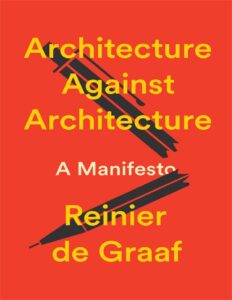
De Graaf, Architecture Against Architecture

Architecture Against Architecture: A Manifesto

After two books of critique – Four Walls and a Roof on the myths architects tell about themselves, architect, verb. on the myths told about them – Reinier de Graaf answers the question those books kept provoking: what should architects do? His starting point is a profession in a crisis of relevance. Measured against climate change, inequality and political instability, architecture’s constructive role is marginal; its “sustainable solutions” do not slow global warming, its work feeds property speculation rather than solving the housing crisis, and its claims to political weight rarely survive contact with reality.

The manifesto proposes fourteen positions in two parts. Under “Architects”: firms rather than founders, collective organisation, co-authorship, the end of unpaid overtime and competitions, a profession open to all, a distrust of taste, a practice rooted in the field. Under “Architecture”: a critique of the fine-arts inheritance, building for and by those who use it, a case for stopping to build, the primacy of what already exists, unlearning Vitruvius, abandoning the language of sustainability, and asking on whose terms architecture is made at all. Verso, 2026.


Download

DeGraaf_Architecture Against Architecture.pdf
DeGraaf_Architecture Against Architecture.txt


RESEARCH & MEASUREMENT

Xenotheka is an experimental, password-protected research library exploring relationships between books, language, computation, and architectural knowledge.

BOOKS & RESEARCH DATA

The book collection is accessible only to authorised users for research and educational purposes. Access is personal. Passwords and access credentials must not be shared.

Full text versions may only be saved or printed for personal use or for research purposes. Books, texts, and protected research materials must not be reproduced, redistributed, published, passed on to third parties, or commercially exploited. Downloaded material must be deleted by completion of the course. Existing copyright notices and rights-holder information must not be removed or altered.

Copyright remains with the respective rights holders. Computational representations, classifications, and relationships between texts are experimental research outputs and may contain errors or interpretive biases.

MEASUREMENT

We study how visitors navigate and explore the library, including interactions with books, searches, visualisations, and research tools.

Entering the library includes taking part in this measurement: Google Analytics records visits, clicks, navigation, and interface interactions. Book contents, passwords, and the full text of searches are not transmitted to Google Analytics.

This agreement covers both sites, Xenotheka (xenotheka.com) and Ask.Alice_ch3n81 (ask.alice-ch3n81.net): agreeing on one is agreeing on the other. It is valid for 24 hours and is then asked again.

Thank you for reading, exploring, and contributing to the experiment.