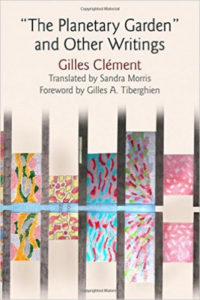
Clement, “The Planetary Garden” and Other Writings

Celebrated landscape architect Gilles Clément may be best known for his public parks in Paris, including the Parc André Citroën and the garden of the Musée du Quai Branly, but he describes himself as a gardener. To care for and cultivate a plot of land, a capable gardener must observe in order to act and work with, rather than against, the natural ecosystem of the garden. In this sense, he suggests, we should think of the entire planet as a garden, and ourselves as its keepers, responsible for the care of its complexity and diversity of life.

“The Planetary Garden” is an environmental manifesto that outlines Clément’s interpretation of the laws that govern the natural world and the principles that should guide our stewardship of the global garden of Earth. These are among the tenets of a humanist ecology, which posits that the natural world and humankind cannot be understood as separate from one another. This philosophy forms a thread that is woven through the accompanying essays of this volume: “Life, Constantly Inventive: Reflections of a Humanist Ecologist” and “The Wisdom of the Gardener.” Brought together and translated into English for the first time, these three texts make a powerful statement about the nature of the world and humanity’s place within it.


Download

Clement_”The Planetary Garden” and Other Writings.pdf
Clement_”The Planetary Garden” and Other Writings.txt


RESEARCH & MEASUREMENT

Xenotheka is an experimental, password-protected research library exploring relationships between books, language, computation, and architectural knowledge.

BOOKS & RESEARCH DATA

The book collection is accessible only to authorised users for research and educational purposes. Access is personal. Passwords and access credentials must not be shared.

Full text versions may only be saved or printed for personal use or for research purposes. Books, texts, and protected research materials must not be reproduced, redistributed, published, passed on to third parties, or commercially exploited. Downloaded material must be deleted by completion of the course. Existing copyright notices and rights-holder information must not be removed or altered.

Copyright remains with the respective rights holders. Computational representations, classifications, and relationships between texts are experimental research outputs and may contain errors or interpretive biases.

MEASUREMENT

We study how visitors navigate and explore the library, including interactions with books, searches, visualisations, and research tools.

Entering the library includes taking part in this measurement: Google Analytics records visits, clicks, navigation, and interface interactions. Book contents, passwords, and the full text of searches are not transmitted to Google Analytics.

This agreement covers both sites, Xenotheka (xenotheka.com) and Ask.Alice_ch3n81 (ask.alice-ch3n81.net): agreeing on one is agreeing on the other. It is valid for 24 hours and is then asked again.

Thank you for reading, exploring, and contributing to the experiment.