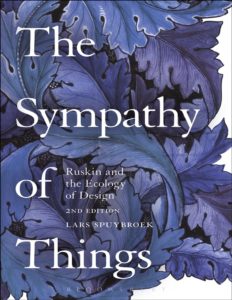
Spuybroek, The Sympathy of Things


‘If there is one thing we can learn from John Ruskin, it is that each age must find its own way to beauty’ writes Lars Spuybroek in The Sympathy of Things, his ground-breaking work which proposes a radical new aesthetics for the digital era. Spuybroek argues that we must ‘undo’ the twentieth century and learn to understand the aesthetic insights of the nineteenth-century art critic John Ruskin, from which he distils pointers for the contemporary age. Linking philosophy, design, and the digital, with art history, architecture, and craft, Spuybroek explores the romantic notion of ‘sympathy’, a core concept in Ruskin’s aesthetics, re-evaluating it as the driving force of the twenty-first century aesthetic experience. For Ruskin, beauty always comprises variation, imperfection and fragility, three concepts that wholly disappeared from our mindsets during the twentieth century, but which Spuybroek argues to be central to contemporary aesthetics and design. Revised throughout, and a new foreword by philosopher Brian Massumi, this is a new edition of a seminal work which has drawn praise from fields as diverse as digital architecture and speculative realism, and will continue to be influential as it wrests Ruskin’s ideas out of the Victorian era and reconstructs them for the modern age.


Download

Spuybroek_The Sympathy of Things.pdf
Spuybroek_The Sympathy of Things.txt


RESEARCH & MEASUREMENT

Xenotheka is an experimental, password-protected research library exploring relationships between books, language, computation, and architectural knowledge.

BOOKS & RESEARCH DATA

The book collection is accessible only to authorised users for research and educational purposes. Access is personal. Passwords and access credentials must not be shared.

Full text versions may only be saved or printed for personal use or for research purposes. Books, texts, and protected research materials must not be reproduced, redistributed, published, passed on to third parties, or commercially exploited. Downloaded material must be deleted by completion of the course. Existing copyright notices and rights-holder information must not be removed or altered.

Copyright remains with the respective rights holders. Computational representations, classifications, and relationships between texts are experimental research outputs and may contain errors or interpretive biases.

MEASUREMENT

We study how visitors navigate and explore the library, including interactions with books, searches, visualisations, and research tools.

Entering the library includes taking part in this measurement: Google Analytics records visits, clicks, navigation, and interface interactions. Book contents, passwords, and the full text of searches are not transmitted to Google Analytics.

This agreement covers both sites, Xenotheka (xenotheka.com) and Ask.Alice_ch3n81 (ask.alice-ch3n81.net): agreeing on one is agreeing on the other. It is valid for 24 hours and is then asked again.

Thank you for reading, exploring, and contributing to the experiment.