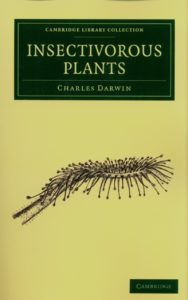
Darwin, Insectivorous Plants

Insectivorous Plants is a book by British naturalist and evolutionary theory pioneer Charles Darwin, first published on 2 July 1875 in London.

Part of a series of works by Darwin related to his theory of natural selection, the book is a study of carnivorous plants with specific attention paid to the adaptations that allow them to live in difficult conditions. It includes illustrations by Darwin himself, along with drawings by his sons George and Francis Darwin.

The book chronicles Darwin’s experiments with various carnivorous plants, in which he carefully studied their feeding mechanisms. Darwin tried several methods to stimulate the plants into activating their trap mechanisms, including feeding them meat and glass, blowing on them and prodding them with hair. He found that only the movement of an animal would cause the plants to react, and concluded that this was an evolutionary adaptation to conserve energy for prey and to ignore stimuli that were not likely to be nutritious. He also discovered that while some plants have distinct trap-like structures, others produce sticky fluids to ensnare their prey and concluded that this was an example of natural selection pressure resulting in various methods for food capture.

The first edition had a reported printing of 3,000 copies. It was translated into several languages during Darwin’s lifetime, including German. A second English-language edition was published in 1889 after Darwin’s death. It was edited with additions and footnotes by Francis Darwin.


Download

Darwin_Insectivorous Plants.pdf
Darwin_Insectivorous Plants.txt


RESEARCH & MEASUREMENT

Xenotheka is an experimental, password-protected research library exploring relationships between books, language, computation, and architectural knowledge.

BOOKS & RESEARCH DATA

The book collection is accessible only to authorised users for research and educational purposes. Access is personal. Passwords and access credentials must not be shared.

Full text versions may only be saved or printed for personal use or for research purposes. Books, texts, and protected research materials must not be reproduced, redistributed, published, passed on to third parties, or commercially exploited. Downloaded material must be deleted by completion of the course. Existing copyright notices and rights-holder information must not be removed or altered.

Copyright remains with the respective rights holders. Computational representations, classifications, and relationships between texts are experimental research outputs and may contain errors or interpretive biases.

MEASUREMENT

We study how visitors navigate and explore the library, including interactions with books, searches, visualisations, and research tools.

Entering the library includes taking part in this measurement: Google Analytics records visits, clicks, navigation, and interface interactions. Book contents, passwords, and the full text of searches are not transmitted to Google Analytics.

This agreement covers both sites, Xenotheka (xenotheka.com) and Ask.Alice_ch3n81 (ask.alice-ch3n81.net): agreeing on one is agreeing on the other. It is valid for 24 hours and is then asked again.

Thank you for reading, exploring, and contributing to the experiment.