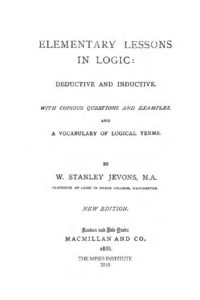
Jevons, Elementary Lessons in Logic


Henry Hazlitt strongly recommended this book for all students of the social sciences. It had a formative influence on his life. In fact, it is the book that taught him how to think.And not only Hazlitt. William Stanley Jevons’s book was the seminal contribution that education many generations of English and American scholars that crucial discipline of logic. It teaches the rules for thinking. Now, this was a subject that every student once had to take, and not in college but quite early in life, and certainly by high school.No more. Today, it is widely assumed that there is no structure of thinking that is worth studying. And perhaps that explains why serious thinking is so rare. It is nothing short of astonishing that most people go all the way through school with no exposure to logic at all.We’ve long looked for a good text to bring into print. Jevons, one of the architects of the Marginal Revolution, is a great choice. To be sure, this book is not easy. It takes patience and discipline. It offers a great challenge to anyone. However, if you can go through the book and learn from it, you will have a massive advantage over colleagues, most of whom have never studied this area. Does it make sense that an economics publishers would bring out a book on logic? Certainly it does from a Misesian point of view. Logic is the method of economic thinking. Without it, indeed, economic theory is not possible. May Jevons school the current generation in the way he did so many previous ones.


Download

Jevons_Elementary Lessons in Logic.pdf
Jevons_Elementary Lessons in Logic.txt


RESEARCH & MEASUREMENT

Xenotheka is an experimental, password-protected research library exploring relationships between books, language, computation, and architectural knowledge.

BOOKS & RESEARCH DATA

The book collection is accessible only to authorised users for research and educational purposes. Access is personal. Passwords and access credentials must not be shared.

Full text versions may only be saved or printed for personal use or for research purposes. Books, texts, and protected research materials must not be reproduced, redistributed, published, passed on to third parties, or commercially exploited. Downloaded material must be deleted by completion of the course. Existing copyright notices and rights-holder information must not be removed or altered.

Copyright remains with the respective rights holders. Computational representations, classifications, and relationships between texts are experimental research outputs and may contain errors or interpretive biases.

MEASUREMENT

We study how visitors navigate and explore the library, including interactions with books, searches, visualisations, and research tools.

Entering the library includes taking part in this measurement: Google Analytics records visits, clicks, navigation, and interface interactions. Book contents, passwords, and the full text of searches are not transmitted to Google Analytics.

This agreement covers both sites, Xenotheka (xenotheka.com) and Ask.Alice_ch3n81 (ask.alice-ch3n81.net): agreeing on one is agreeing on the other. It is valid for 24 hours and is then asked again.

Thank you for reading, exploring, and contributing to the experiment.