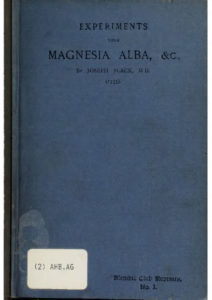
The research on the nature of alkalinity, which Black conducted for his thesis, laid the basis for the most important paper of his career, “Experiments upon Magnesia Alba, Quicklime, and Some Other Alcaline Substances,” given to the Philosophical Society of Edinburgh in 1755. The earlier series of experiments for his thesis were conducted on magnesium salt and, for the first time, consisted of a planned cyclic series of quantitative experiments in which a balance was used at all stages. He found that with acids, magnesia alba behaved in a similar way to chalk (calcium carbonate), giving off a gas. He then heated a sample of the starting compound and found that the product, magnesia usta (now known as magnesium oxide), like quicklime (calcium oxide), did not effervesce with acids. Unlike quicklime, however, it was not caustic or soluble in water. Black hypothesized that the weight lost during heating was due to the gas generated. He then added a solution of potash (potassium carbonate) to the magnesia usta and showed that the product weighed the same as his original sample of magnesia alba. The difference between the alba and usta was therefore the gas, which Black called “fixed air.” It could be introduced to the latter to re-create the former by means of the potash.
Download
Black_Experiments upon Magnesia, Alba, Quicklime and some other Alcaline Substances.pdf
Black_Experiments upon Magnesia, Alba, Quicklime and some other Alcaline Substances.txt