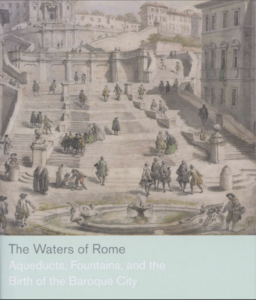
Rinne, The Waters of Rome


In this pioneering study of the water infrastructure of Renaissance Rome, urban historian Katherine Rinne offers a new understanding of how technological and scientific developments in aqueduct and fountain architecture helped turn a medieval backwater into the preeminent city of early modern Europe. Supported by the author’s extensive topographical research, this book presents a unified vision of the city that links improvements to public and private water systems with political, religious, and social change. Between 1560 and 1630, in a spectacular burst of urban renewal, Rome’s religious and civil authorities sponsored the construction of aqueducts, private and public fountains for drinking, washing, and industry, and the magnificent ceremonial fountains that are Rome’s glory. Tying together the technological, sociopolitical, and artistic questions that faced the designers during an age of turmoil in which the Catholic Church found its authority threatened and the infrastructure of the city was in a state of decay, Rinne shows how these public works projects transformed Rome in a successful marriage of innovative engineering and strategic urban planning.


Download

Rinne_The Waters of Rome.pdf
Rinne_The Waters of Rome.txt


RESEARCH & MEASUREMENT

Xenotheka is an experimental, password-protected research library exploring relationships between books, language, computation, and architectural knowledge.

BOOKS & RESEARCH DATA

The book collection is accessible only to authorised users for research and educational purposes. Access is personal. Passwords and access credentials must not be shared.

Full text versions may only be saved or printed for personal use or for research purposes. Books, texts, and protected research materials must not be reproduced, redistributed, published, passed on to third parties, or commercially exploited. Downloaded material must be deleted by completion of the course. Existing copyright notices and rights-holder information must not be removed or altered.

Copyright remains with the respective rights holders. Computational representations, classifications, and relationships between texts are experimental research outputs and may contain errors or interpretive biases.

MEASUREMENT

We study how visitors navigate and explore the library, including interactions with books, searches, visualisations, and research tools.

Entering the library includes taking part in this measurement: Google Analytics records visits, clicks, navigation, and interface interactions. Book contents, passwords, and the full text of searches are not transmitted to Google Analytics.

This agreement covers both sites, Xenotheka (xenotheka.com) and Ask.Alice_ch3n81 (ask.alice-ch3n81.net): agreeing on one is agreeing on the other. It is valid for 24 hours and is then asked again.

Thank you for reading, exploring, and contributing to the experiment.